

AEO, or answer engine optimization, is the work of making your pages the source a search engine or AI assistant uses when it answers a question directly instead of handing over a list of links. The term grew up around Google's featured snippets and voice assistants, and today it mostly means showing up in AI answers such as Google's AI Overviews and ChatGPT. It runs on the same foundations as SEO; what changes is the target and how you measure success.
Most explanations of AEO give a definition and a list of tactics, and skip the history. The history is worth ten minutes, because each kind of answer box changed one thing a business owner should know: how many sources an answer draws on, and what the site gets back. This article walks through that, then sets out what a business website should do. AEO is one part of organic search and visibility in AI answers, the work onlyspell files under its Globe Spell.
What is AEO (answer engine optimization)?
AEO is shaping a page so an answer engine can pick out a passage, use it in a direct answer and credit your site. An answer engine is any system that replies with an answer: a featured snippet in Google, a voice assistant reading a result aloud, or an AI tool writing a summary from several pages.
The definitions in circulation differ mainly in emphasis. Ahrefs describes AEO as "the practice of making your content visible and useful to AI systems" that give direct answers, and counts Google's AI Overviews, voice assistants and chatbots such as ChatGPT and Claude among them. HubSpot puts the goal in brand terms: improving "how often and how accurately a brand or product appears in AI-generated answers." Both are fair. For a business site, the practical version is narrower: when a customer asks a question your business can answer, the answer should come from your page and carry your name.
You'll also meet GEO, a newer label that overlaps with AEO and has its own explainer in this series.
Where did AEO come from?
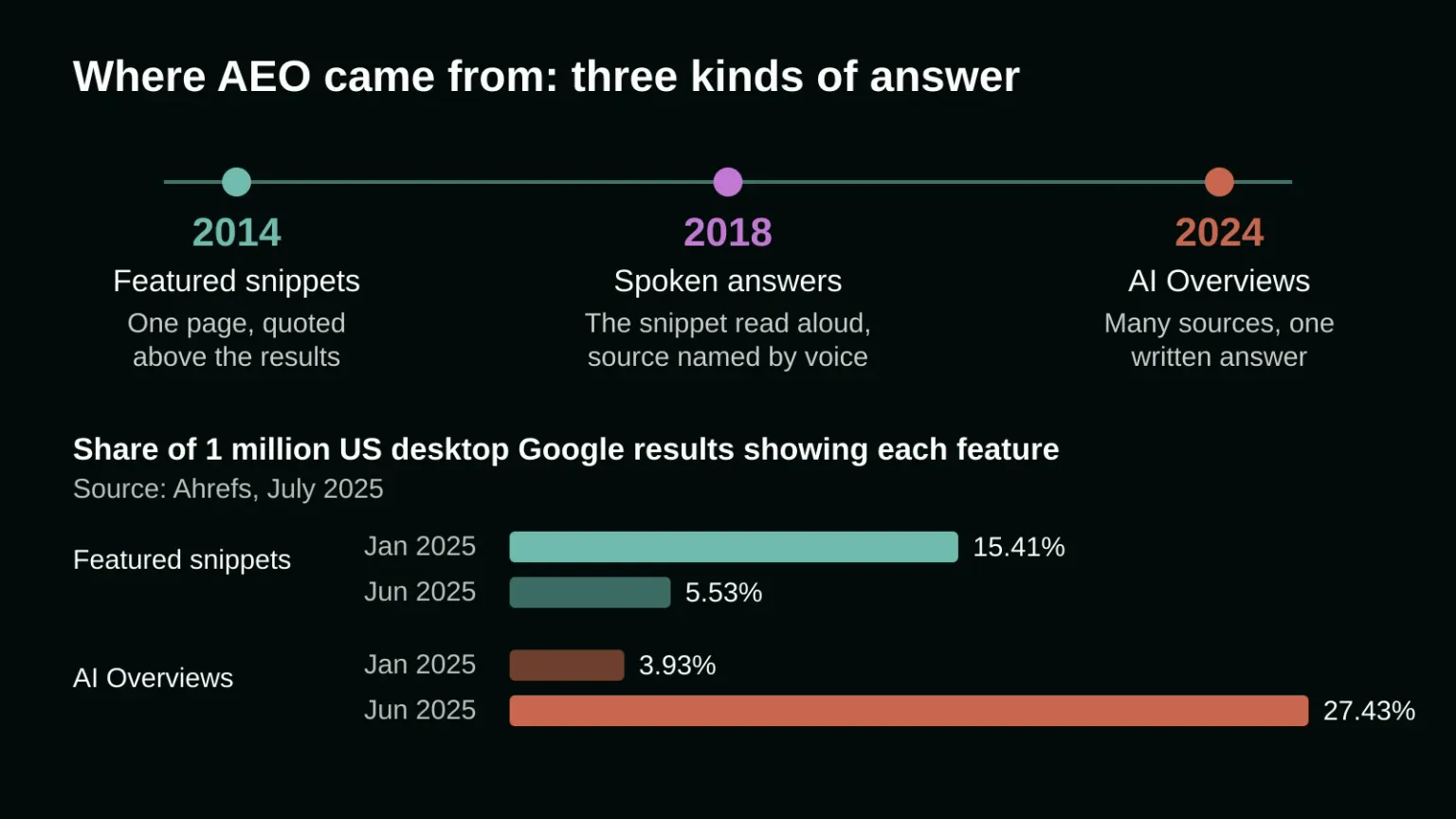
AEO grew out of three kinds of answer that Google and others added over ten years. Featured snippets, launched in January 2014, quoted one page above the results. Voice assistants then read those snippets aloud and named the source. Since 2024, AI Overviews and chatbots write one answer from many pages, and that's what most people mean by AEO now.
2014: featured snippets, one page quoted
A featured snippet is the box that shows a short extract from one page above the normal results, with a link to it. In a January 2018 post, Google's Danny Sullivan wrote that Google "introduced featured snippets in January 2014" and that they were "especially helpful for those on mobile or searching by voice." The deal for the site was simple. One page won the box, its words were shown more or less as written, and its link sat right there.
2018: voice assistants read the answer aloud
The same post said that with the growth of voice assistants, more people were asking spoken questions, and that for those answers Google would "cite the source page in the spoken result" and link to it in the Google Home app. A spoken answer has no list to fall back on, so being the source meant being the only result the listener heard.
Google also built markup for this, called speakable, and it's still a narrow beta. Its documentation describes it as a feature that that "works for users in the U.S. that have Google Home devices set to English," aimed at news content. One part of it is useful to any business, though: Google recommends "around 20-30 seconds of content" per section, roughly two to three sentences. That's a sound length for any answer you want quoted, spoken or not.
2024: AI answers built from many pages
On 14 May 2024 Google announced that AI Overviews would "begin rolling out to everyone in the U.S.," with the aim of reaching "over a billion people by the end of the year." An AI Overview doesn't quote one page. It writes its own answer and lists several supporting links. Google says AI Overviews and AI Mode may use "query fan-out," running several related searches across subtopics before writing the answer.
Ahrefs checked one million randomly chosen US desktop results and found featured snippets on 15.41% of them in January 2025 and 5.53% in June, while AI Overviews went from 3.93% to 27.43% over the same months. Ahrefs itself notes that the two trends moving together doesn't prove one caused the other. Still, the box that early AEO advice aimed at is shrinking, and the AI answer is growing in its place.
How is AEO different from SEO?
AEO and SEO use the same foundations: a page that search engines can crawl, index and show with a snippet. The difference is the goal. SEO aims for a high-ranking page and a click. AEO aims for one passage to be used inside an answer and credited, which can happen even when nobody clicks.
On the technical side, Google is clear that there's nothing extra to do. Its page on AI features says there are "no additional requirements to appear in AI Overviews or AI Mode, nor other special optimizations necessary," beyond being indexed and eligible to appear with a snippet. If you want the basics of that foundation first, read what SEO is and how it works for a business website.
Three things do change, and they're the reason the term is more than a rebrand.
- The unit is a passage. SEO judges a page. An answer engine lifts a few sentences, so each answer on your page has to make sense on its own.
- A top ranking no longer decides who gets cited. In an Ahrefs study of 863,000 keyword results and 4 million AI Overview links, published in March 2026, 37.1% of the cited pages ranked in Google's top 10 organic results and 36.7% didn't rank in the top 100 at all. A page further down can win the citation for one of the hidden sub-questions.
- Success is measured differently. A citation in an AI answer may send no visit. You count mentions and cited links as well as clicks.
The skeptics have a point too. CXL quotes a Reddit user who couldn't see how the new labels "meaningfully differ from traditional SEO practices," and warns that many agencies are "repackaging SEO fundamentals with new terminology and charging a premium." For the work itself, that's mostly right: clear pages, real expertise and a site search engines can read. Where AEO earns its own name is in the scoreboard, and in writing each answer so it survives being cut out of the page.
What control does a site owner have over answer engines?
Very little in the positive direction. Google says plainly that you can't mark up a page to become a featured snippet, and the same holds for AI Overviews. What you do control is the opposite: the snippet settings nosnippet, data-nosnippet and max-snippet decide what Google may show from a page, in featured snippets and AI answers alike.
The AEO guides that rank for this question skip this part. On its featured snippets page, Google answers the question of how to mark a page as a featured snippet with two words: "You can't." Its systems decide. The controls it does offer all limit or refuse. The nosnippet rule blocks every snippet for a page, featured or regular. The data-nosnippet attribute keeps a marked piece of text out of snippets. Lowering max-snippet makes long extracts less likely, though Google notes it isn't a guarantee. And Google's AI features page names the same three controls, plus noindex, as the way to limit what appears in AI Overviews and AI Mode.
Two practical points follow. First, check that nobody added one of these settings by accident; a stray nosnippet on a service page makes it ineligible for every answer box at once. Second, data-nosnippet has a real business use: put it on details that go out of date or mislead when quoted alone, such as a price that changes every season. Everything else in AEO is content work.
What should a business website do about AEO?
Make sure Google and the AI search crawlers can reach and quote your pages, then write a short, self-contained answer to each question customers ask before they buy, near the top of the right page. Add the details only your business has, such as prices, process and area. Then track citations as well as clicks.
In order of effort, for a typical service or shop site:
- Check eligibility. Pages indexed, snippets allowed, and search crawlers not blocked. Which AI crawlers to allow is covered in our guide to getting cited in AI answers.
- List the questions. Ten or so that people ask before they contact you: what it costs, how long it takes, whether you cover their area, what happens first. Give each one a heading on the page where it belongs.
- Answer in two or three sentences, then expand. The 20 to 30 seconds Google suggested for spoken answers is a good guide. Name the subject in the sentence and keep conditions next to the claim; the sentence-level rules are in how to write content AI assistants will quote.
- Add what only you can say. An answer engine has a dozen pages that explain the general case. Your price range, your lead times and your service area are facts it can only get from you.
- Measure the new way. Ask the main assistants your customers' questions every month or two and note whether you're named or linked, alongside your normal traffic figures.
What to skip: packages that sell AEO as a separate product with its own tags or files. Google says its AI features need no special optimizations beyond normal indexing, so most of what's on offer is SEO under a new name. If you'd like a second opinion on which pages and questions to start with, talk to us about your site.
Frequently asked questions
Is AEO replacing SEO?
No. AEO depends on SEO, because answer engines such as Google's AI Overviews only use pages that are crawled, indexed and eligible for a snippet. AEO adds a different goal on top of it: being the passage an answer is built from, and being credited for it.
Is there markup that gets a page into AI Overviews?
No. Google says there are no additional requirements or special optimizations for AI Overviews and AI Mode beyond normal indexing, and that you can't mark up a page to become a featured snippet. The controls site owners have, such as nosnippet and data-nosnippet, only limit what Google shows.
Are featured snippets still worth chasing?
They're worth less than they were. Ahrefs found featured snippets on 15.41% of one million US desktop Google results in January 2025 and on 5.53% in June 2025, while AI Overviews rose to 27.43%. The same work serves both: a clear, short answer under a heading that matches the question.
Sources
- Google: A reintroduction to Google's featured snippets (Danny Sullivan, 30 January 2018)
- Google Search Central: Featured snippets and your website
- Google Search Central: Speakable structured data (beta)
- Google: Generative AI in Search (Elizabeth Reid, 14 May 2024)
- Google Search Central: AI features and your website
- Ahrefs: How SERP features have evolved in the AI era (July 2025)
- Ahrefs: Update: 38% of AI Overview citations pull from the top 10 (March 2026)
- Ahrefs: What is answer engine optimization (AEO)?
- HubSpot: What is answer engine optimization (AEO)?
- CXL: How AEO/GEO is changing search (Tarek Reslan)
If you still need additional help in developing and designing your website, our magic is here to help. Contact us today, and our wizards will help you immediately with your digital marketing needs!