
To write content AI assistants quote, write passages that still make sense when someone copies them out of your page with nothing around them. Each one names its subject, carries its own numbers and conditions, and makes one claim per sentence. Then give it something worth quoting: a figure, a source or a specific detail the other pages don't have.
Whether an assistant can reach your site at all is a separate question, and it's covered in our guide to getting cited in AI answers: crawlers, robots.txt, and why there's no special tag to buy. This article stays on the page itself, sentence by sentence. It's the part of AEO and AI search visibility that a business owner can fix with a text editor this afternoon.
What makes a passage easy for an AI assistant to quote?
A quotable passage survives being cut out. It names what it's about instead of saying "it" or "this", keeps the condition and the number in the same sentence, and answers the heading directly. Microsoft's guide for AI search describes it as "sentences that make sense even when pulled out of context."
That guide, published by Microsoft Advertising in October 2025, is one of the few pieces of advice on this topic written by a company that runs an AI answer engine. Most of what ranks for this query comes from agencies and tool vendors, and they mostly agree with each other: answer first, short paragraphs, question headings, add statistics. That advice is right, as far as it goes. What it rarely shows is what a passage looks like before and after, or which of those tactics were ever tested.
The cut-out test: how to check a paragraph in two minutes
Copy one paragraph into an empty document. Delete the heading above it. Now read it as a stranger would, because that's roughly what happens when an assistant pulls a chunk of your page into an answer: the paragraph arrives alone, next to text from other sites.
Here's a passage that fails:
It doesn't need any. Google says so on its documentation page, and the same goes for the other one we mentioned above.
Cut out, nobody knows what "it" is, what it doesn't need, or which "other one" was mentioned. Here's the same idea rewritten to pass:
A page doesn't need special markup to appear in Google's AI Overviews. Google's documentation says there are "no additional requirements to appear in AI Overviews or AI Mode, nor other special optimizations necessary."
The second version is longer by a few words. It names the subject, names the product, names the source and quotes it. An assistant can lift it whole, and so can a person writing a report.
Run the test on the five pages that bring you the most enquiries, starting with the paragraphs right under each heading. Those are the ones most likely to be pulled out.
Which writing changes made AI engines quote a page more?
In the best-known controlled study on this, adding quotations, statistics and cited sources raised a page's visibility in generated answers by 30 to 40% on the researchers' main measure. Keyword stuffing did slightly worse than leaving the page alone. The biggest gains went to pages ranked fifth; pages ranked first lost visibility.
The study is GEO: Generative Engine Optimization, a 2023 paper by researchers from IIT Delhi, Princeton University and independent labs, accepted at the KDD 2024 conference. They built a benchmark of 10,000 queries, rewrote source pages with nine different methods, and measured how much of each page's text made it into the generated answer, weighted by how early it appeared.
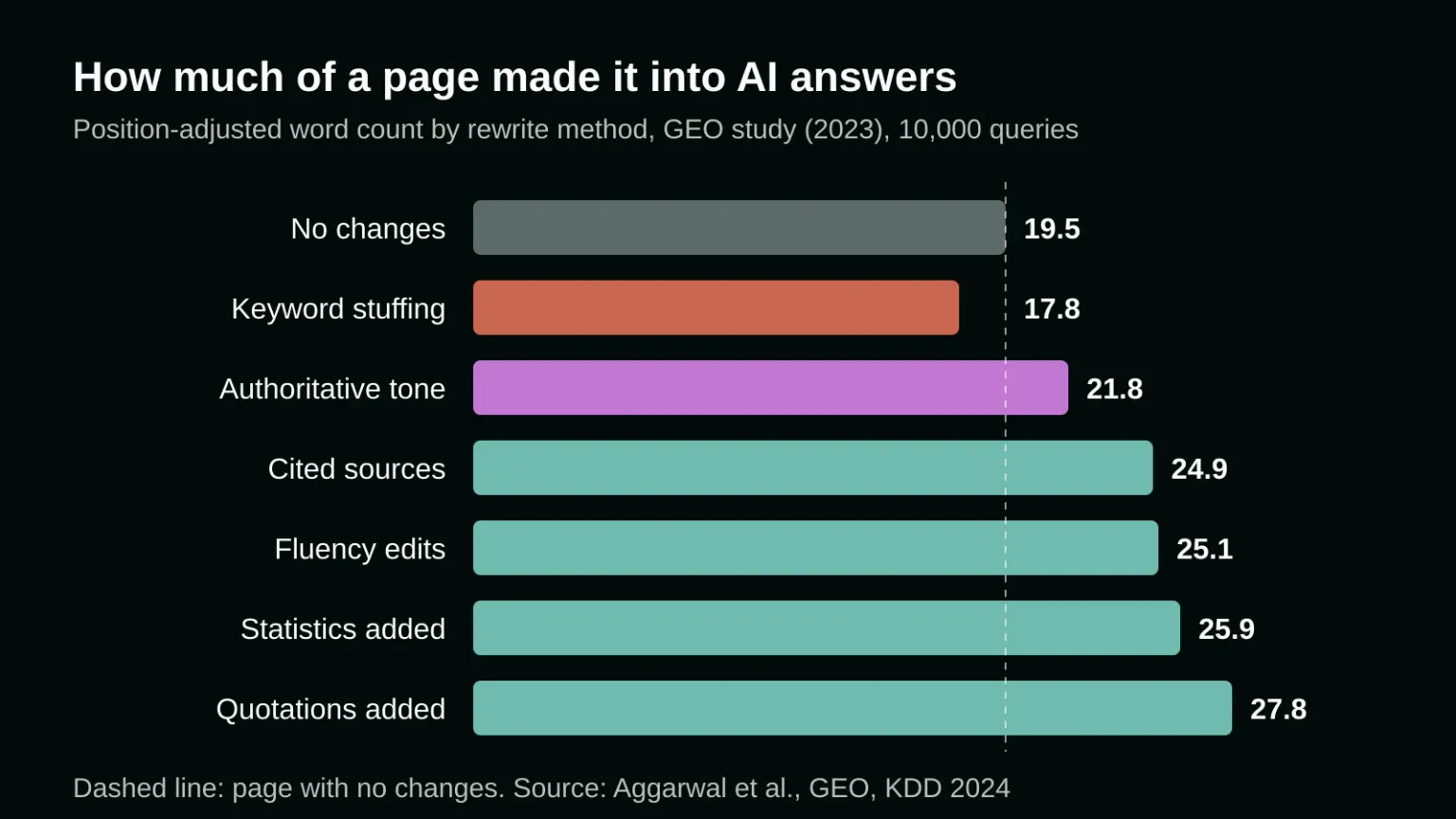
Three things in the results are worth acting on:
- Evidence beat style. Adding a relevant quotation scored 27.8 against a baseline of 19.5, the best result. Statistics scored 25.9 and cited sources 24.9. Rewriting in a more authoritative, persuasive tone reached only 21.8.
- Old SEO habits didn't carry over. Keyword stuffing scored 17.8, below the untouched pages.
- Smaller sites gained most. For pages ranked fifth in the search results, citing sources raised visibility by 115.1%. For pages ranked first, the same change lowered it by 30.3%.
Treat the numbers with care. The main tests ran on a research engine built on GPT-3.5 Turbo, with a smaller check on Perplexity.ai that showed gains of up to 37%. None of it measured live ChatGPT or Gemini traffic, and today's assistants pick sources differently. The direction is still useful for a small business: a page that brings a real figure and names where it came from gives an answer engine something it can't get from the page ranked above it.
Sentence rules that make a page quotable
Most of these take minutes to apply, and each one also makes the page easier for a human to skim.
Name the subject, every time it matters
Pronouns like "it", "this" and "they" point back to something outside the sentence. Inside your page that's fine; in an AI answer the thing they point to is gone. Use the noun again at the start of each paragraph and in any sentence that might be quoted alone. Repeating "the water heater" three times reads better than you think.
Keep the condition in the same sentence as the claim
"Delivery takes three days. That's for orders inside the city." Lift only the first sentence and the answer is wrong for half your customers. Write "Orders inside the city arrive within three days" and the limit travels with the claim.
One claim per sentence
Microsoft's guide warns that "packing multiple claims into one line makes it harder for AI (and readers) to parse meaning." A sentence that lists your price, your guarantee and your opening hours gets quoted for one of them, with the other two hanging off it. Split it.
Replace adjectives with things that can be checked
The same guide uses a dishwasher as its example: "42 dB dishwasher designed for open-concept kitchens" instead of "quiet dishwasher." It adds that terms like "innovative" or "eco" "mean little without specifics." A number with its unit, a date or a named standard can be quoted. "Premium quality" can't.
Call one thing by one name
If your page says "quote", "estimate" and "proposal" for the same document, a machine reading three chunks may treat them as three things. Pick the word your customers use and keep it.
Where should the answer sit on the page?
Put the answer in plain visible text, directly under a heading that states the question. Microsoft notes that AI systems may not render content hidden in tabs or expandable menus, and Google lists making sure important content is in textual form among its practices for AI features. An answer inside an image or a closed accordion may never be read.
Headings do more work than most site owners give them credit for. Microsoft calls them "chapter titles that define clear content slices" and contrasts a heading like "Learn More" with "What Makes This Dishwasher Quieter Than Most Models?" The second one tells a machine exactly which question the next paragraph answers.
A few layout habits work against you:
- Prices, opening hours or service areas shown only in a graphic or a PDF.
- FAQ answers that only exist inside a collapsed accordion. If you keep the accordion, make sure the text is in the page's HTML, not loaded after a click.
- Decorative arrows, star ratings drawn with characters and strings of exclamation marks, which Microsoft says "break parsing."
- Long unbroken blocks of text, which Microsoft says "blur ideas together and make it harder for AI to separate content into usable chunks."
Can a page be too easy to quote?
Yes, if the only thing it offers is a tidy answer everyone else also gives. Then the assistant quotes someone, and it doesn't matter much whether it's you. Google's May 2025 advice for AI search tells site owners to focus on "unique, non-commodity content", which is the half of the job that formatting can't do.
Google also notes that people in AI search are "asking longer and more specific questions." That favours pages that answer the specific version. "How much does a website cost" has a thousand tidy answers. "What does it cost to move a 40-page site with a booking system to a new platform" has very few, and a page that answers it with real ranges and what drives them is the one worth quoting.
So the order of work is: first make sure you have something only your business can say, such as your prices, your process, your numbers with dates. Then write each piece of it so it survives the cut-out test. The writing rules on their own produce a clean page that sounds like every other clean page.
If you'd like onlyspell to rewrite your most important pages so they pass the cut-out test and still sound like you, tell us which pages bring in your customers and we'll start there.
Frequently asked questions
Do AI assistants prefer lists or paragraphs?
Neither format is preferred by rule. Microsoft's guidance for AI search recommends concise, self-contained phrasing "in lists, Q&As, and tables" and warns against long walls of text. Use a list when the content really is a list of separate items, and short paragraphs when the points depend on each other.
Should every section start with a short direct answer?
Every section that answers a question should, because the sentences right under a heading are the ones most easily pulled into an AI answer. Keep that opening answer complete on its own, with the subject named and any condition included. The detail, examples and sources can follow below it.
Does adding statistics really make AI cite a page more?
In the 2023 GEO study, adding relevant statistics raised a page's share of AI-generated answers from 19.5 to 25.9 on the researchers' main measure, and adding quotations raised it to 27.8. The test used a research engine and a benchmark of 10,000 queries, so treat it as a direction, not a promise. Only add figures you can source.
Sources
- Microsoft Advertising: Optimizing your content for inclusion in AI search answers (October 2025)
- Aggarwal et al.: GEO: Generative Engine Optimization (arXiv, accepted at KDD 2024)
- Google Search Central: AI features and your website
- Google Search Central Blog: Top ways to ensure your content performs well in Google's AI experiences on Search (May 2025)
If you still need additional help in developing and designing your website, our magic is here to help. Contact us today, and our wizards will help you immediately with your digital marketing needs!