SEO (search engine optimization) is the work of making a website easy for search engines to find, understand and show to people looking for what you offer. For a business site that comes down to a short list: pages Google can index, one clear page per service, a complete Google Business Profile if you serve a local area, and other sites that mention you. Most of the rest sold as SEO is optional, and Google itself says some of it does nothing.
This guide covers what SEO is today, its parts, and the order in which a small business should spend its time on them. It's the base layer of the organic search and AI visibility work that onlyspell does, and it's written for owners who want to be able to judge an SEO plan when someone hands them one.
What is SEO?
SEO is everything you do so a search engine can find your pages, understand them and decide they answer a search well. Google describes it as "helping search engines understand your content" and helping people decide whether to visit your site. The results it earns are unpaid, unlike ads, and they build up over months.
Search engines do three jobs, in order. They crawl the web to find pages, index the pages they can read, and rank the indexed pages for each search. Google's own starter guide says it "primarily finds pages through links from other pages it already crawled," which is why a site nobody links to can sit unseen for a long time. Ranking happens page by page, so your contact page, your service pages and your blog posts each compete on their own.
There's no secret switch. Google's starter guide puts it plainly: "There are no secrets here that'll automatically rank your site first in Google." Its page on hiring help adds that "No one can guarantee a #1 ranking on Google."
Which SEO advice can a business ignore?
Google's SEO Starter Guide has a section on things it believes you shouldn't focus on. It includes several items that SEO checklists still sell: the meta keywords tag, which Google Search doesn't use; keywords in the domain name; hitting a word count; and the order of headings. Skipping them frees time for the work that counts.
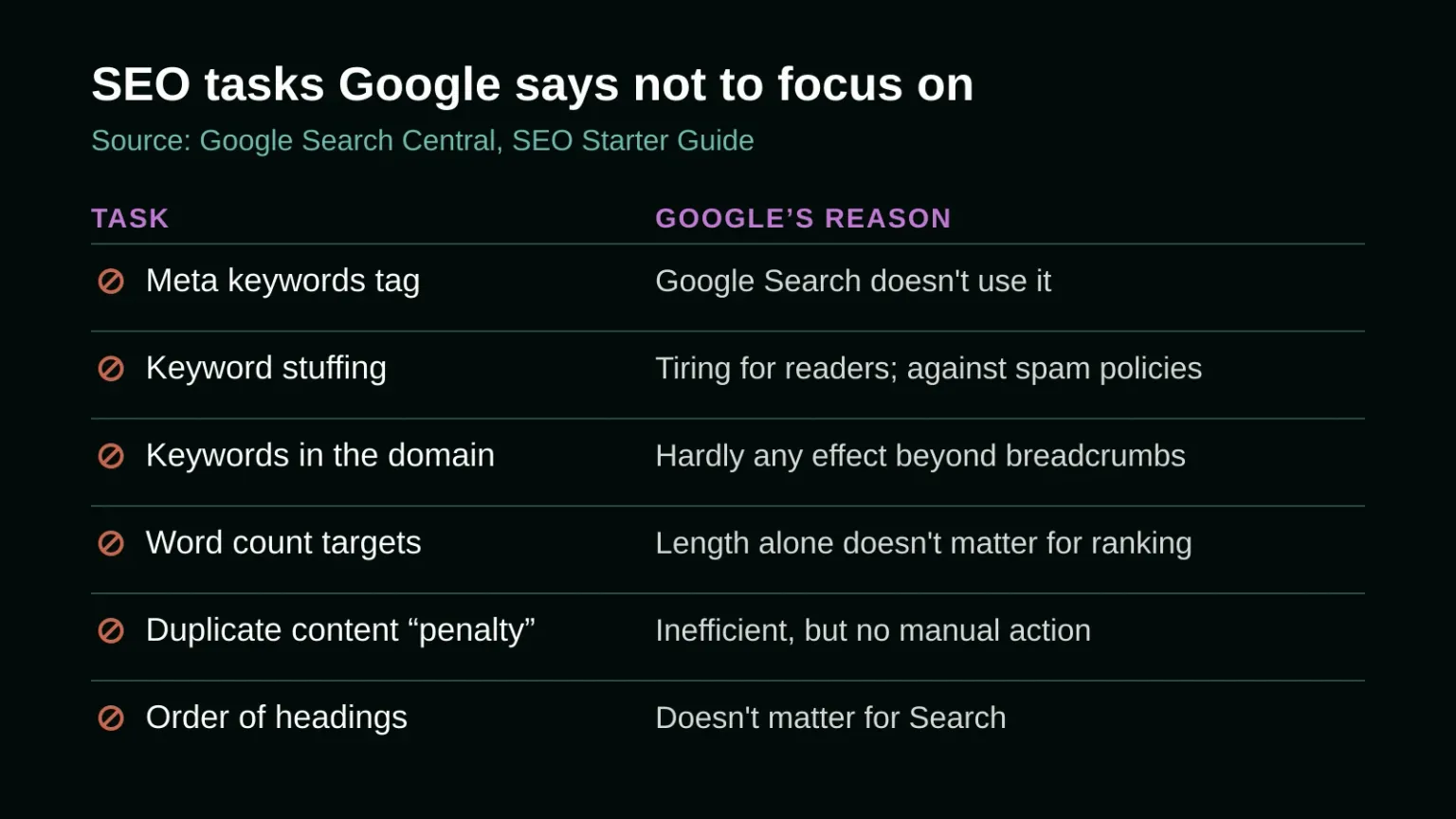
Each item on that list has a reason attached, and the reasons are worth knowing when someone pitches you an audit:
- Meta keywords: "Google Search doesn't use the keywords meta tag."
- Keyword stuffing: repeating the same words "is tiring for users," and Google adds that keyword stuffing is against its spam policies.
- Keywords in the domain or URL: they "have hardly any effect beyond appearing in breadcrumbs." Pick a domain for your brand.
- Content length: "The length of the content alone doesn't matter for ranking purposes." A 400-word service page that answers the question is fine.
- Duplicate content: having the same text at two addresses is inefficient, Google says, but "it's not something that will cause a manual action." Copying other people's content, Google adds, "is a different story."
- Number and order of headings: for Search, "it doesn't matter if you're using them out of order," though a clean order still helps people using screen readers.
The rule behind the list is that Google ranks a page on whether it helps the person searching, so tricks aimed at the machine age badly. If an audit you paid for spends its first pages on meta keywords and word counts, ask what it found about indexing and service pages instead.
What are the main parts of SEO?
SEO is usually split into four parts. Technical SEO makes sure search engines can reach and read your pages. On-page SEO, or content, is what each page says and how. Off-page SEO is what other sites say about you, mostly through links and mentions. Local SEO covers maps and nearby searches for businesses that serve an area.
Technical SEO
This is the plumbing. Google's Search Essentials call the technical requirements "the bare minimum that Google Search needs from a web page in order to show it in search results": Googlebot isn't blocked, the page works (it isn't an error page), and it has indexable content. Speed and mobile layout sit here too; if you want to know which speed metric to fix first, read our guide to Core Web Vitals. Google suggests submitting a sitemap, a file listing the addresses you care about, but says it "isn't required" and that making sure people know about your site comes first.
On-page SEO and content
Google's own advice here is short: write "helpful, reliable, people-first content" and "use words that people would use to look for your content." The second point is where most business sites slip. A plumbing company's page titled "Solutions" competes for nothing; a page titled "Emergency boiler repair in Haifa" competes for exactly the people who'll call. Structured data belongs here as an add-on, and only a few types still pay off for a small business, as our schema markup guide explains.
Off-page SEO
Links do two jobs. They're how Google finds most new pages ("the vast majority of the new pages Google finds every day are through links"), and they count as a signal of reputation, though Google calls PageRank "just one" of many signals. For a small business, the useful links are ordinary ones: suppliers, partners, local associations, press, directories in your trade. Search Essentials sums the work up as "Tell people about your site." Google's page on hiring help adds a warning worth remembering: "You should never have to link to an SEO."
Local SEO
If customers come to you or you go to them, your Google Business Profile can matter more than your website for local searches. Google says local results are mainly based on three factors: relevance (how well the profile matches the search), distance from the person searching, and prominence (how well known the business is, which Google also calls popularity). Google's help page is clear that "There's no way to request or pay for a better local ranking on Google." So the work is a complete, accurate profile, the right categories, and real reviews over time.
What should a business website actually do about SEO?
Work in this order: confirm Google can index your pages, give every service its own page in your customers' words, complete your Business Profile if you're local, fix the slowest pages, then earn mentions from sites in your field. Measure with Search Console, and give each change a few weeks before you judge it.
- Connect Google Search Console and check which of your pages are indexed. A page that isn't indexed can't rank, and this is the cheapest problem to find.
- Map each thing you sell to one page. Title it with the words a customer would type, and answer the questions they ask before they call: price range, area, how long it takes.
- If you serve a local area, fill in every field of your Business Profile and keep it matching your site.
- Fix speed and mobile problems on the pages that bring in leads first, usually the home page and the main service pages.
- Get listed and linked where your customers already look: trade directories, partners, local news.
- Track it. The Search Console Performance report shows clicks, impressions, click-through rate and average position for the searches that showed your site. Its default view covers the last three months.
Blogging comes after this list for most small businesses. An article helps when it answers a question your buyers search for. Ten generic posts on a site whose service pages Google can't index won't help at all.
Does SEO still matter when AI answers the question?
Yes. Google says there are "no additional requirements to appear in AI Overviews or AI Mode, nor other special optimizations necessary," and that SEO best practices "remain relevant" for its AI features. A page that ranks and reads clearly is the same page AI answers pick up, so SEO is the foundation the newer work stands on.
The same Google page adds that you don't need "new machine readable files, AI text files, or markup" to appear in those features. That's worth repeating to anyone selling a separate AI package before your basics are done. Newer names for this kind of visibility, such as AEO and GEO, describe work that starts from the same base. What changes is how you check results: an AI answer can quote you without sending a click, and our guide to getting cited in AI answers covers what makes a page quotable.
How long does SEO take, and how do you hire help?
Google's starter guide says "Some changes might take effect in a few hours, others could take several months," and suggests waiting a few weeks before judging a change. A new site with few links takes longest, because Google finds pages mainly through links.
When you hire, Google's own advice is a good filter. Ask whether the provider follows Search Essentials and how they measure success. Walk away from anyone who guarantees first place; Google's words are "find someone else." It also warns about firms that "email you out of the blue." Among the services Google lists as normal for an SEO are reviewing site structure, keyword research, content development and "optimizing for generative AI."
If you'd like a second opinion on what your site needs, or the whole spell cast for you, talk to us about your website.
Frequently asked questions
What is SEO in simple terms?
SEO is the work of making a website easy for search engines to find, understand and show for relevant searches. It covers how the site is built, what its pages say, and what other sites say about it. The visits it earns are unpaid, unlike search ads.
Can a small business do SEO itself?
Yes, the basics are manageable without a specialist: check indexing in Google Search Console, give each service a clear page in customers' words, and complete a Google Business Profile. Help is worth paying for with technical problems, a site migration or a crowded market. Google advises avoiding anyone who guarantees a first-place ranking.
Do I need different SEO for Google's AI Overviews?
No. Google says there are no additional requirements or special optimizations needed to appear in AI Overviews or AI Mode, and that normal SEO best practices still apply. You also don't need new files or markup for those features.
Sources
- Google Search Central: SEO Starter Guide
- Google Search Central: Google Search Essentials
- Google Search Central: Do you need an SEO?
- Google Search Central: AI features and your website
- Google Business Profile Help: Tips to improve your local ranking on Google
- Search Console Help: Performance report (Search results)
If you still need additional help in developing and designing your website, our magic is here to help. Contact us today, and our wizards will help you immediately with your digital marketing needs!