

E-E-A-T stands for experience, expertise, authoritativeness and trust: the four qualities Google's search quality raters look for when they judge the quality of a page. Trust sits at the centre, and the other three support it. E-E-A-T is not a score and not a single ranking factor; for a business site, earning it mostly means making it easy to check who you are, what you've done and what other people say about you.
Most guides to E-E-A-T turn the four letters into a checklist of things to add. Google's own documents are more useful, because the Search Quality Rater Guidelines describe the actual steps a rater takes when they land on a website, including the searches they run about it. This article goes through those documents and then turns the rater's routine into a check you can run on your own site, as one part of organic search and AI visibility.
What does E-E-A-T mean in Google's guidelines?
In Google's Search Quality Rater Guidelines, E-E-A-T is the set of questions raters ask about a page and its creator: is it accurate and honest, does the creator know the subject first-hand or professionally, and is the site a known source for it? The guidelines call trust "the most important member" of the four.
The current edition of the guidelines is dated September 11, 2025 and runs to 182 pages. Section 3.4 defines each letter with an everyday example:
- Experience: whether the creator has "the necessary first-hand or life experience for the topic." The example is a product review by someone who used the product against one by someone who didn't.
- Expertise: whether the creator has "the necessary knowledge or skill." Home rewiring advice from a skilled electrician beats the same advice from an antique homes enthusiast.
- Authoritativeness: whether the creator or site is "known as a go-to source for the topic." The guidelines say a local business's own social media page may be the authoritative source for what is on sale now.
- Trust: "the extent to which the page is accurate, honest, safe, and reliable."
Trust carries the weight because, in the guidelines' words, "untrustworthy pages have low E-E-A-T no matter how Experienced, Expert, or Authoritative they may seem." Their example is a financial scam run by a highly experienced scammer. Google's helpful content guidance adds that content "doesn't necessarily have to demonstrate all of them": a page can earn its place through experience alone, or through expertise alone.
The first E is the newest. Google added it on December 15, 2022, in a post by Elizabeth Tucker that put it simply: "E-A-T is gaining an E: experience."
Is E-E-A-T a Google ranking factor?
No. Google's helpful content guidance says "E-E-A-T itself isn't a specific ranking factor." Its systems use a mix of other signals that tend to identify content with good E-E-A-T, and they give those signals more weight on topics that affect health, money or safety. Rater scores don't move any page.
Raters are real people who score sample results, and their scores are used to check whether Google's ranking systems are working. The guidelines tell them directly that "no single rating can directly impact how a particular webpage, website, or result appears in Google Search." Google's helpful content page compares the ratings to "feedback cards from diners" at a restaurant: the feedback tells the kitchen whether the recipe works, and it doesn't change any one plate.
So there's nothing to switch on and no E-E-A-T number to raise. The guidelines are a description, written for people, of what Google wants its algorithms to reward. For the wider picture of how search engines find and rank pages, see what SEO means for a business website.
The stakes rise with the topic. Google gives "even more weight to content that aligns with strong E-E-A-T" on topics that could affect people's health, financial stability or safety, which it calls "Your Money or Your Life" (YMYL) topics. A clinic, an accountant or an online shop that takes payments is held to a higher standard than a café's menu page.
How a quality rater checks a business website
The guidelines tell raters to form their view of E-E-A-T from three kinds of evidence: what the website says about itself, what others say about it, and what is visible on the page. The second one is where most business sites are weakest, and it's the one you can check yourself today.
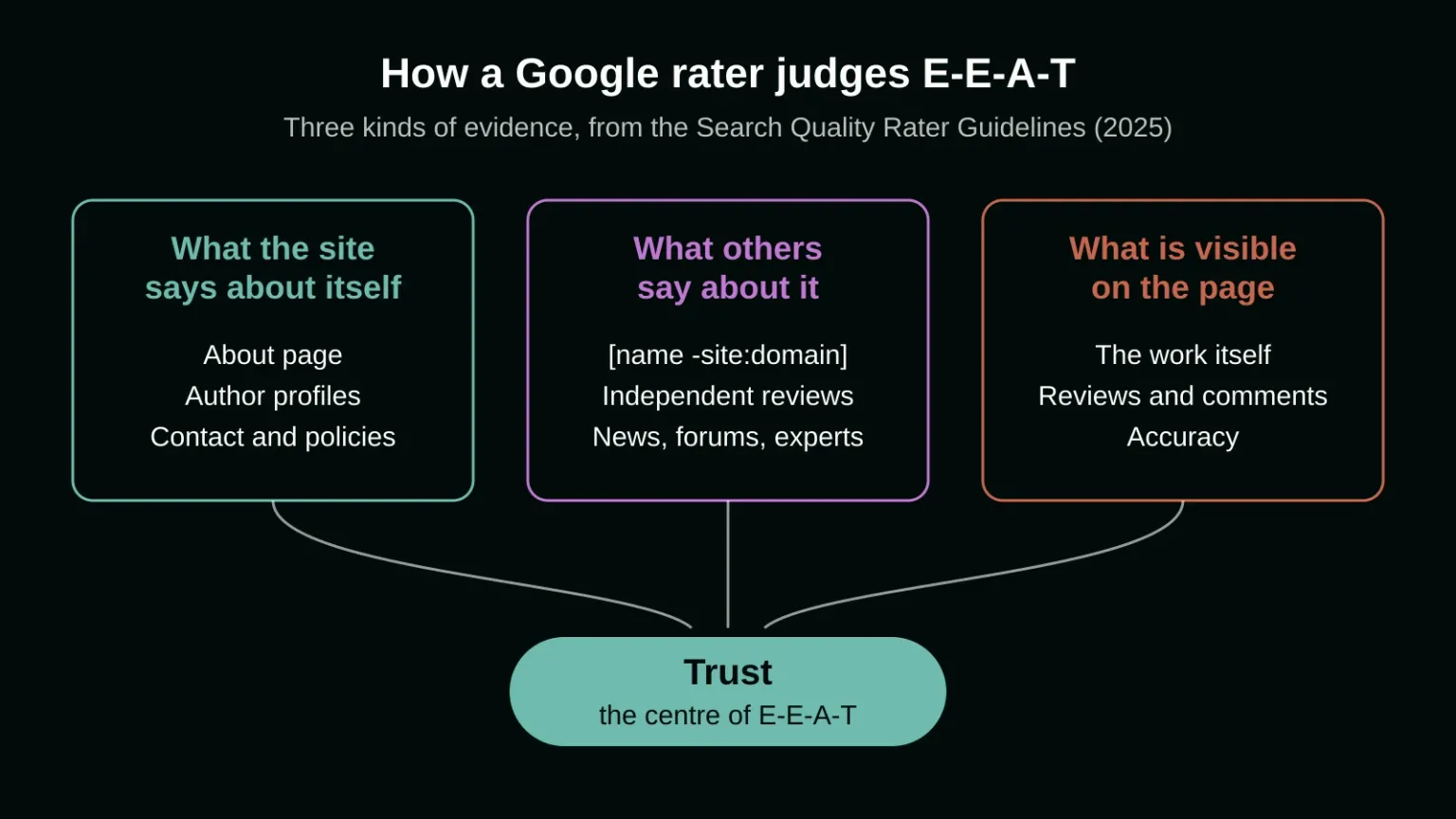
For the first, raters start with the About page or the creator's profile. The guidelines say every page should make clear who is responsible for the website and who created the content, and that contact and customer service details are "extremely important for websites that handle money." For a shop, raters are told to look for the payment, exchange and returns policies.
For the second, the guidelines spell out the searches. Using IBM as their example, they suggest queries like these, each of which leaves out the company's own site:
- [ibm -site:ibm.com]
- ["ibm.com" -site:ibm.com]
- [ibm reviews -site:ibm.com]
- ["ibm.com" reviews -site:ibm.com]
Run the same four searches with your business name and your domain. What comes up is roughly what a rater would see: reviews, directory listings, perhaps a local news piece or a forum thread. If the results show an old address, a different phone number or a complaint nobody answered, that's the first thing to fix, and it costs nothing.
For the third, raters look at the main content itself. Sometimes expertise is obvious from the work, and the guidelines' example is a hairdresser whose skill you can see by watching them style hair in a video. For a business site, the equivalent is a project page with real photos, the problem, what was done and the result.
What counts for less than most guides suggest
Your own testimonials page is weaker evidence than you might think. The guidelines tell raters to "be skeptical of claims that websites make about themselves, particularly when there is a clear conflict of interest," and their example of a weak review is the manufacturer saying "Our product is great!" Quotes you picked and published yourself sit closer to that than to an independent review on a platform you don't control.
Star ratings alone don't settle it either. Raters are told to be skeptical of both positive and negative reviews, because "anyone can write them, including the website owner," and to read what the reviews actually say. A few negative reviews are, per the guidelines, "completely normal and expected." Detailed, credible reports of fraud are what count as a seriously negative reputation, while a single rude clerk or one late parcel shouldn't.
Traffic numbers are ignored outright. The guidelines name Similarweb and say traffic data does "not provide evidence of positive or negative reputation."
Having little reputation online isn't held against you. The guidelines say small websites "may have little or no reputation information" and that "this is not indicative of high or low quality," noting that many small local businesses rely on word of mouth. In that case raters are told to pay more attention to everything else on the page.
What can a business website show to earn E-E-A-T?
Show who is behind the site, with real names, contact details and an About page that says what the business does. Show the work itself, with specific project or case pages. Put a byline on articles that links to the author's profile. Then make sure what others say about you, in reviews and listings, matches what you say.
Google's helpful content guidance frames this as three questions: Who created the content, How it was made, and Why. Translated into a business site, that gives a short list:
- A plain About page that says who owns the business, who works there and where it operates. Raters start here.
- Contact details that are easy to find, and for a shop the payment and returns policies.
- Bylines that link to an author page. Google asks whether bylines "lead to further information about the author," with background on the areas they write about.
- Project pages with photos of your own work and the numbers from a real job. This is the first E, and only you can supply it.
- The same name, address and phone number on your site, your Google Business Profile and the directories that list you, so the four searches above find one business.
- A note on how a page was made when AI or automation wrote much of it. Google suggests such disclosures where readers would reasonably expect them.
Fake people are the one thing to avoid completely. Google's guidance says that fabricating creator profiles "such as by using AI-generated headshots, made-up names, or false credentials" is a form of deception, and that any deception makes a page untrustworthy to both people and Google's systems. A team page with stock photos and invented job titles does more harm than no team page.
The last question is the one Google calls "perhaps the most important": why the content exists. A page written to help the people who come to your site directly is aligned with E-E-A-T. A page written mainly to attract search visits isn't, however many credentials sit next to it. If you also want those pages to be quoted by ChatGPT or Google's AI features, that's a related job, covered in our guide to getting cited in AI answers.
At onlyspell, this kind of work starts with the About page, the project pages and the four searches above. If you'd like a second pair of eyes on how your site reads to someone checking whether to trust it, talk to us about your website.
Frequently asked questions
When did Google add experience to E-A-T?
Google added experience on December 15, 2022, turning E-A-T into E-E-A-T in an update to its Search Quality Rater Guidelines. The extra E asks whether content shows first-hand involvement, such as having actually used a product or visited a place.
Does adding an author bio improve Google rankings?
Google doesn't say an author bio raises rankings by itself. Its helpful content guidance strongly encourages accurate bylines that lead to more information about the author, because clear authorship helps people judge whether to trust a page. A fake or exaggerated bio does the opposite, since Google treats fabricated creator profiles as deception.
Does E-E-A-T matter for a small local business website?
Yes, though the bar depends on the topic: Google holds pages on health, money and safety to a higher standard than, say, a café's opening hours. Google's rater guidelines also say that a small site with little reputation information online is not a sign of low quality. For a small business, a clear About page, real contact details and honest reviews go a long way.
Sources
If you still need additional help in developing and designing your website, our magic is here to help. Contact us today, and our wizards will help you immediately with your digital marketing needs!