
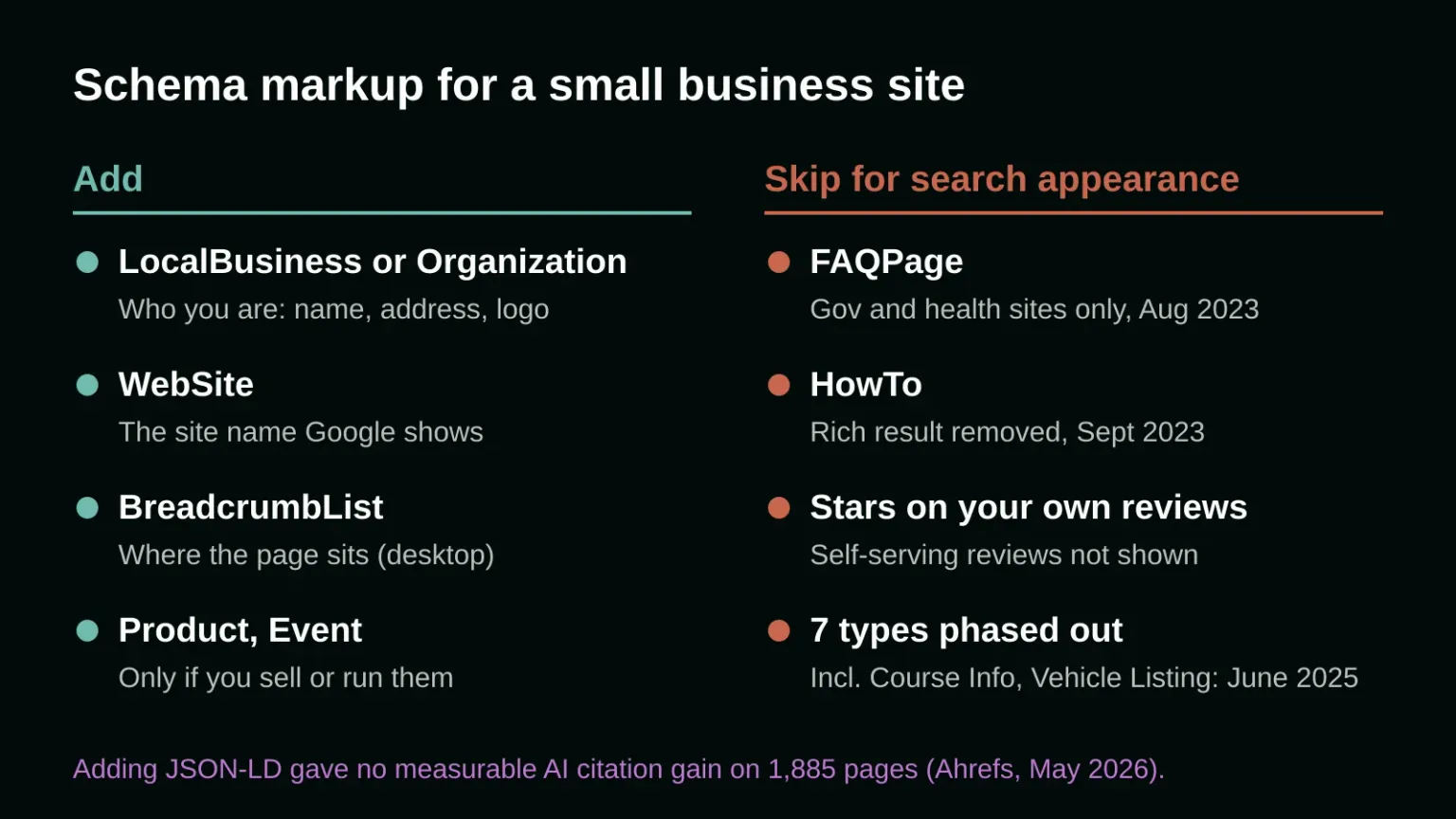
A small business website needs only a few types of schema markup: Organization or the most specific LocalBusiness type on the home page, WebSite for the site name, BreadcrumbList on inner pages, and Product or Event only if you sell products or run events. FAQ and HowTo markup no longer earn anything for most businesses. And adding schema won't, on its own, get you cited by ChatGPT or Google's AI answers.
Most guides on this subject hand you a list of six to ten types and suggest you add them all. The trouble is that Google has switched off several of the results those types used to produce, and the lists haven't caught up. This article sorts the common types by what each one still does in 2026, so you can spend an afternoon on the markup that counts and skip the rest. Structured data is one small part of organic search and visibility in AI answers, and it's the part that's easiest to overdo.
Which schema markup does a small business website need?
Start with one block describing the business on the home page: LocalBusiness, in its most specific subtype, if customers visit you or you serve a local area, or Organization if you don't. Add WebSite markup on the home page and BreadcrumbList on inner pages. Product, Event or Course markup only belongs on sites that actually offer those things.
LocalBusiness or Organization: who you are
Google's LocalBusiness documentation requires just two properties, name and address, and recommends opening hours, telephone, URL, geo coordinates and price range. It also tells you to "use the most specific LocalBusiness sub-type possible," so a dentist marks up as Dentist and a spa as DaySpa, not as a generic business. That one choice tells search engines more than a dozen extra properties.
If you sell online or work with clients remotely and have no premises to visit, use Organization instead. Google lists no required properties for it and recommends putting it on the home page or the About page, not on every page. Its suggested minimum is short: the name, an address or phone number, the website and a logo. The logo property can influence which logo Google shows in results and in your knowledge panel; the image has to be at least 112 by 112 pixels. Add sameAs links to your real profiles elsewhere so your business can be told apart from others with a similar name.
WebSite: the name above your result
Google shows a site name above each result, and it doesn't always pick the one you'd want. Its site-name guide says WebSite structured data on the home page is the most important signal "if you want to specify a preference." It needs only name and url, with alternateName for a short form or acronym. The catch: it works per domain or subdomain, and only from the home page.
BreadcrumbList: where the page sits
Breadcrumb markup describes a page's place in the site, for example Home, then Services, then Teeth whitening. It needs at least two items, each with a position. Google's documentation lists the feature as available on desktop and says nothing about phones. On a five-page site it adds little; on a site with service categories or a shop, it's worth the half hour.
Product, Event and the rest: only if they're real
Product markup with price and availability suits a shop. Event markup suits a venue or a school with dated sessions. If neither describes your business, leave them out. A type that doesn't match what's on the page earns nothing and breaks Google's guidelines.
Which schema types no longer pay off?
FAQ markup stopped showing for most sites in August 2023, when Google limited FAQ rich results to well-known government and health websites. HowTo rich results were removed entirely a month later. Review stars about your own business aren't shown either, and in 2025 Google phased out seven more features.
FAQ schema is still on many "must-have" lists, and for a plumber or a law firm it now does nothing visible in Google. That doesn't mean you have to rip it out. Google said at the time that there's "no need to proactively remove it" and that unused structured data "does not cause problems for Search." Just don't spend new hours adding it.
Review stars are the one that disappoints owners most. Google's review snippet guidelines say that when the business being reviewed controls the reviews about itself, the page is ineligible for star review features. For LocalBusiness and Organization, review markup is meant only for sites that collect reviews about other businesses. So the testimonials on your own home page, marked up with five stars, won't produce stars in search.
Then the 2025 cuts. On 12 June 2025, Google announced it would phase out Book Actions, Course Info, Claim Review, Estimated Salary, Learning Video, Special Announcement and Vehicle Listing from its results, saying the change "won't affect how pages are ranked." For a small business the two that matter are Course Info, if you run a training school, and Vehicle Listing, if you sell cars. Google says use of the markup outside its Search isn't affected, but it no longer changes how you look in Google.
Does schema markup help you get cited in AI answers?
The best evidence so far says no, at least for pages AI systems already see. Ahrefs tracked 1,885 pages that added JSON-LD between August 2025 and March 2026 and found no meaningful rise in citations in Google AI Overviews, AI Mode or ChatGPT. Google itself says structured data isn't required for its AI features.
The Ahrefs study, published on 11 May 2026, is worth reading because it tested cause rather than correlation. An earlier look at 6 million URLs had found AI-cited pages almost three times more likely to carry JSON-LD, which is where a lot of "schema for AI" advice comes from. When Ahrefs compared pages that added schema with about 4,000 similar pages that didn't, ChatGPT citations moved by +2.2% and AI Mode by +2.4%, both indistinguishable from zero. AI Overviews citations fell 4.6%, and since both groups were already declining before the change, the authors couldn't say schema caused it. Their conclusion: "if you're already doing the rest of the SEO work well, JSON-LD isn't going to be the unlock."
Google's guide to its generative AI features says the same in plain words: "Structured data isn't required for generative AI search, and there's no special schema.org markup you need to add." It still recommends structured data because it makes pages eligible for rich results.
Two limits keep this from being the final word. Every page in the Ahrefs sample already had at least 100 AI Overview citations before any schema was added, so a new site that no AI system has noticed yet is a different case, which the authors say the study couldn't test. And the window was 30 days. What gets a business named in an AI answer is mostly the content itself, covered in this guide to getting cited in AI answers. If you've been told to publish a file for AI bots as well, read what llms.txt does and who reads it first; the evidence there points the same way.
How do you add schema markup without breaking anything?
Write it as JSON-LD, the format Google recommends, in a script block in the page. Describe only what visitors can see on that page, keep the details identical to your Business Profile, and check each page type in Google's Rich Results Test before and after publishing.
Your website platform or an SEO plugin may already output some schema. Before adding your own, run your home page through the Rich Results Test and see what's there. Two plugins that each print an Organization block with a different phone number send mixed signals, and that's easier to fix before you add a third.
The rule that gets businesses into trouble is the visibility one. Google's general guidelines say "Don't mark up content that is not visible to readers of the page." Opening hours in the markup that appear nowhere on the page, or a service area the site never mentions, break that rule. A structured data problem can bring a manual action, which removes the page's eligibility for rich results.
After that, the upkeep is small. When your hours, phone number or address change, update the markup in the same edit as the page. Out-of-date markup is worse than none, because it tells search engines something you've already stopped telling customers. The simplest protection is markup generated from the same content as the page, in the site's templates, so the two can't drift apart.
If you'd like onlyspell to check what your site's markup holds and what it should, talk to us about your website.
Frequently asked questions
Is schema markup a ranking factor?
Google's documentation presents structured data as a way to understand a page and to make it eligible for rich results, and it says even correct markup doesn't guarantee one. When Google retired seven rich result types in June 2025, it said the change wouldn't affect how pages rank.
Should a local business still add FAQ schema?
Not for search appearance. Since August 2023, Google shows FAQ rich results only for well-known government and health websites. Existing FAQ markup doesn't cause problems and doesn't have to be removed, but adding it to a business site won't change how it looks in Google.
Can I add star ratings from my customer reviews?
You can add the markup, but Google won't show the stars. Its review snippet guidelines make a page ineligible for star review features when the business being reviewed controls the reviews about itself. For LocalBusiness and Organization, review markup is meant only for sites that collect reviews about other businesses.
Sources
- Ahrefs: We tracked 1,885 pages adding schema. AI citations barely moved (May 2026)
- Google Search Central: Optimizing your website for generative AI features
- Google Search Central: Local business structured data
- Google Search Central: Organization structured data
- Google Search Central: Site names in Google Search
- Google Search Central: Breadcrumb structured data
- Google Search Central: Review snippet structured data
- Google Search Central blog: Changes to HowTo and FAQ rich results (August 2023)
- Google Search Central blog: Simplifying the search results page (June 2025)
- Google Search Central: General structured data guidelines
- Google Search Central: Introduction to structured data markup
If you still need additional help in developing and designing your website, our magic is here to help. Contact us today, and our wizards will help you immediately with your digital marketing needs!